
- Published on
42 Network
The 42 Network is redefining software engineering education through hands-on, project-based learning. With campuses worldwide and recognition from major rankings, it produces self-sufficient engineers who excel at problem-solving and rapid adaptation.
- Authors

- Name
- John Decorte
- Bluesky
The 42 Network is a global institution offering intensive, project-based software engineering education—completely tuition-free. What makes it unique is its approach: instead of traditional lectures and exams, students learn by building real projects, solving complex problems independently, and teaching each other. This method produces engineers with exceptional practical skills, strong collaboration abilities, and a proven capacity to learn new technologies quickly.
Founded with campuses across North America, Europe, Asia, and beyond, 42 has earned recognition from the World's Universities with Real Impact (WURI) rankings, regularly placing alongside institutions like MIT and Stanford for innovation and industry impact.
How It Works: Project-Based Learning
Unlike traditional universities, 42 has no lectures or professors. Instead, students progress through an extensive curriculum of hands-on coding projects, developing skills through three key mechanisms:
- Collaborative Problem-Solving: Students work together to understand concepts and debug issues, developing strong communication skills and the ability to explain technical concepts clearly. This mirrors real workplace environments where engineers regularly collaborate and share knowledge.
- Code Review & Defense: Every completed project undergoes evaluation by three peer students. The author must present their work, explain their architectural decisions, and defend their implementation choices. This process ensures deep understanding—not just surface-level completion—and builds presentation skills valuable in professional settings.
- Self-Directed Progress: Students advance through a curriculum of increasingly complex projects at their own pace. This structure rewards initiative, teaches time management under deadlines, and develops the self-sufficiency essential for modern tech careers where continuous learning is required.
The Curriculum: From Fundamentals to Specialization
The curriculum is organized as a progression of projects, each building on previous knowledge:
Foundation Phase: All students begin with low-level systems programming in C, the foundation of modern computing. Projects include:
- Recreating standard library functions from scratch to understand how software works at the fundamental level
- Building a Unix shell to learn process management and system calls
- Implementing memory management utilities to master pointer manipulation and efficiency
- Creating custom implementations of core functions like
printf
This foundation ensures graduates understand not just high-level frameworks, but how computers actually execute code—a skill that distinguishes strong engineers from those who only know frameworks.
Specialization Phase: After mastering fundamentals, students choose focus areas aligned with their career interests:
- Graphics Programming: Raycasting engines, 3D rendering, and computer graphics
- Web Development: Full-stack applications with modern frameworks
- Systems & Security: Kernel programming, cybersecurity, and low-level optimization
- Artificial Intelligence: Machine learning and data science applications
- DevOps & Infrastructure: System administration and deployment automation
Built-in Accountability: Students work within time-bound milestones that simulate real project deadlines, teaching prioritization and delivery under pressure—essential skills for professional software development.
Credentials & Recognition
The 42 Network has earned significant recognition from the international education community:
WURI Rankings: The World's Universities with Real Impact (WURI) evaluates institutions based on innovation and measurable societal contribution rather than traditional metrics like research papers. In these rankings:
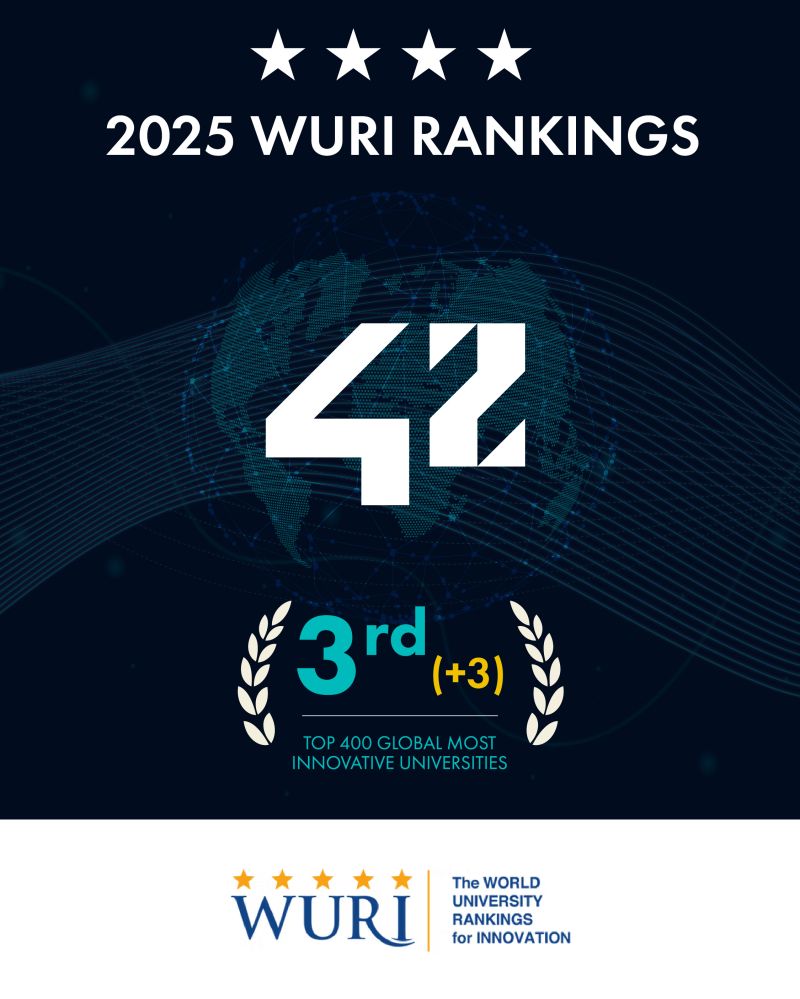
- #1 in Ethical Value (Multiple Years): Recognized globally for providing world-class technical education with no tuition costs, no prerequisite degrees, and open access based purely on demonstrated ability and commitment.
- Top 100 Innovative Universities: 42 consistently ranks alongside MIT, Stanford, and Harvard in innovation-focused rankings, validating its educational approach.
- Industry Impact: WURI specifically highlights 42's exceptional record of producing engineers who enter the workforce ready to contribute immediately, with demonstrated ability to build production-grade software.
What This Means for Hiring: Graduates from 42 have passed through a rigorous selection process (see below) and completed hundreds of hours of hands-on coding projects. They possess portfolios of actual working software, proven collaboration skills, and the self-sufficiency to learn new technologies independently—qualities consistently cited by employers as more valuable than traditional academic credentials.
Selection Process: The Intensive Bootcamp
Admission to 42 doesn't require a résumé, test scores, or prior programming experience. Instead, candidates participate in an intensive 26-day evaluation program called the "Piscine" (French for "Swimming Pool"):
What It Tests:
- Adaptability: Candidates with no prior coding experience must learn C programming from scratch under time pressure
- Work Ethic: Participants typically work 12-15 hours daily, including weekends, demonstrating commitment and endurance
- Collaboration: Success requires asking questions, helping peers, and working effectively in a team environment
- Self-Sufficiency: With no instructors, candidates must research solutions independently, read documentation, and debug complex problems
- Resilience: The intensity is deliberate—those who persevere through initial struggles and maintain determination are selected
Why This Matters: The Piscine's selection rate is typically around 30%. Those who complete 42's full curriculum have demonstrated not just technical ability, but the soft skills essential for high-performing engineering teams: persistence, collaboration, communication, and continuous learning.
Key Skills Developed
Beyond programming languages and technical knowledge, 42 graduates develop competencies particularly valuable in modern tech environments:
Continuous Learning: In an industry where frameworks and tools evolve constantly, the ability to learn independently is more valuable than memorized knowledge. 42 graduates have proven they can master new technologies without formal instruction—they read documentation, experiment with code, and solve problems from first principles.
Problem-Solving Under Constraints: Working through complex projects without instructor guidance builds strong analytical and debugging skills. When 42 graduates encounter novel challenges in the workplace, they systematically break down problems, research solutions, and implement fixes independently.
Clear Technical Communication: The mandatory code review process means every graduate has experience explaining technical decisions, defending architectural choices, and presenting their work—skills essential for code reviews, technical interviews, and cross-functional collaboration.
Collaboration & Mentorship: The peer-learning model develops both the ability to seek help effectively and the patience to mentor others—traits that strengthen any engineering team's culture and productivity.
What to Look For in 42 Graduates
When evaluating candidates from 42, you'll notice several distinguishing characteristics:
Portfolio-First Approach: Rather than relying solely on academic credentials, 42 graduates typically present GitHub repositories filled with completed projects demonstrating hands-on experience with real code. Common projects include custom shells, graphics engines, web applications, and system-level utilities.
Deep Fundamentals: The C-based foundation means graduates understand memory management, pointer arithmetic, data structures, and algorithms at a low level—knowledge that translates to writing more efficient code in any language and debugging complex system-level issues.
Project Completion Under Deadline: Having worked through dozens of time-bound projects, they bring experience with scope management, prioritization, and delivering working software within constraints—not just proof-of-concept code.
Self-Starter Mentality: The educational model requires extreme self-direction. These candidates won't wait for detailed instructions—they'll take initiative, research solutions, and propose approaches independently.
Bottom Line
The 42 Network represents an alternative path into software engineering that emphasizes practical skills, project-based learning, and proven ability over traditional academic credentials. Its graduates enter the workforce with extensive hands-on coding experience, demonstrated collaboration skills, and the self-sufficiency to tackle new technologies independently—qualities that directly translate to productivity in professional engineering environments.
For companies seeking engineers who can contribute immediately, learn quickly, and thrive in collaborative environments, 42 graduates offer a track record of exactly these capabilities, validated through intensive project work rather than theoretical coursework.